
High Society
Ogunquit Playhouse, Ogunquit, ME, August 2, 2025
Reviewed by John Amodeo
Ogunquit Playhouse kept up its season’s buoyant momentum with its current production of High Society that had the audience happily humming the songs of Cole Porter’s tuneful score on their way out. The portrayal of the vagaries of the social upper classes was vaguely amusing, and the boy-lost-girl, boy-wants-girl-back, boy-may-or-may-not get-girl-back plot was nothing new. Still, this production provided such spectacular singing and dancing, laced with comic wit and even some important life lessons learned, that one couldn’t help but love this show.
Unlike many other musicals from the golden age of Broadway, High Society as a stage musical never had a straightforward journey toward the success it certainly is enjoying in Ogunquit right now. The musical’s source material, Philip Barry’s 1939 romantic comedy play, The Philadelphia Story, was so popular that a year later it was made into a highly successful film of the same name that starred Katherine Hepburn, Cary Grant, and Jimmy Stewart. The story was one that could be easily musicalized, but it wasn’t until 1954 that Hollywood stepped in, added nine Cole Porter songs to the story, and dubbed it High Society, starring Frank Sinatra, Bing Crosby, and Grace Kelly. Despite the film’s success, High Society wasn’t adapted for the stage for more than four decades when a not-fully-cohesive production eventually opened on Broadway in 1998; it closed after only four months.
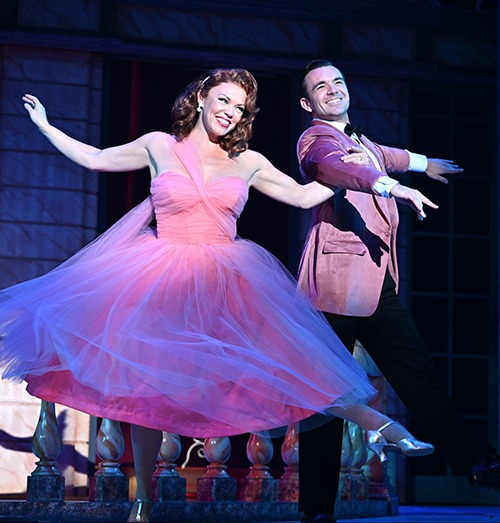
Photo by Gary Ng
The Ogunquit Playhouse’s creative team saw promise in it. Executive Artistic Director Brad Kenney did some retooling, BT McNicholl worked on the book, Greg Jarrett and Sam Davis worked on the score. With choreography by Jeffry Denman and direction by Matt Lenz (Broadway’s Hairspray and Catch Me If You Can), this High Society held together beautifully and moved swiftly from beginning to end like a cleverly crafted gavotte. Plot points were tightened, some songs were cut, some new Porter songs were added, and dramatic scenes were introduced or heightened, all of which brought depth and purpose to the central characters. Borrowing the best elements from its past iterations, including the original source material, the story was presented clearly, with just enough romantic tension to keep us engaged, and Porter’s beautifully sung score and Denman’s expertly danced period-perfect choreography kept us entertained throughout.
This new “revisal” set the story back to its original 1958 Newport, Rhode Island setting, shortly after the Newport Jazz Festival began in 1954. That allowed this production to infuse the score with jazz-inflected vitality. The story involved the impending wedding of heiress Tracy Lord (played by quadruple threat Robyn Hurder) fresh off her star turn in Broadway’s Smash) whose family resided in one of Newport’s grandest baronial mansions. This was to be Tracy’s second marriage, and her ex-husband, Dexter, played by versatile song-and-dance man Max Clayton (Chicago, Music Man), who lived in the mansion next door and was intentionally not invited. Dexter decided to crash the wedding, much to the delight of Tracy’s mother Margaret, a delightfully arch Sara Gettelfinger (Water for Elephants, Dirty Rotten Scoundrel) and her precocious adolescent sister Dinah (played to the hilt by the talented Charlotte Van Ledtje). This was much to Tracy’s chagrin. Her fiancé George, played with the right level of buffoonery by Charlie Franklin (Floyd Collins), had the social standing Dexter lacked, which made him a much more ideal husband in Tracy’s materialistic mind than Dexter, who had given up a successful career for show business. Dexter remained undeterred, and of course, drama and hilarity ensued.
A new character, Cholly Knickerbocker, the leader of a jazz trio, was played by the irrepressible Ari Groover and served throughout the show as a Greek chorus that commented on the plot as she spoke and sang directly to the audience. Because she and the trio were not as fully integrated into the plot as they might have been, the show got off to a slow start during their underwhelming title number. However, the minute Hurder and Clayton brought their stunning singing and dancing to the stage and the large and talented ensemble broke into their dance numbers with Denman’s vibrant choreography, the show soared and didn’t let up until the curtain call. It was a pleasure to see Hurder and Clayton, both superbly talented dancers, front and center as they led the spellbinding ensemble in their big jazz and tap-dancing numbers. Hurder and Clayton’s romantic ballroom dance on the terrace during “After You, Who?” was elegant and smooth; they glided over the parquet and barely touched it, easily reminiscent of Fred Astaire and Ginger Rogers.
In addition to being a fine dancer, Hurder is an incredible singer, actor, and comedian. She has a versatile voice, not unlike Dolores Gray’s with its deep alto shades, its strong belt, and an equally finely dialed dynamic range that could coo and whisper softly. Her comic timing and sarcastic barbs hit their mark every time, and her dramatic scenes were equally compelling. Tracy had the farthest to travel in personal growth, and Hurder took her the full distance. Clayton, a modern-day Gene Kelly, was appropriately rakish, and his chemistry with Hurder was palpable. He commanded every one of his scenes with boundless charm and easily had the audience in his camp rooting for Dexter to wear down Tracy’s resistance and win her back.
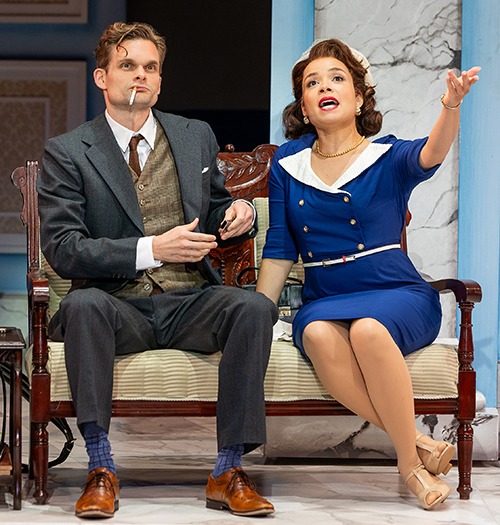
Photo by Nile Scott Studios
The secondary characters were all vital to the intricately woven plot and provided apt foils for our hero and heroine. As writer Mike Connor and photographer Liz Imbrie, both sent by Spy magazine to cover Tracy and George’s wedding, Andrew Durand and Sydney Morton, respectively, were well matched to each other and to our leads in talent and presence. Durand, just off Broadway’s Dead Outlaw, was especially fun in his drunken duet with Clayton in “Well, Did You Evah?” Both were barely balancing on balustrades as they tipsily raised their champagne glasses in song and dance during the pre-wedding cocktail party and brought down the house. Morton’s Liz was a forthright and committed journalist, but her unrequited love for Mike presented formidable challenges that she was determined to overcome. Her rich alto slid effortlessly into her mix and had its finest moment as she wittily dressed down Mike in “It Must Be Fun to Be You,” an obscure Porter song that should be heard more often.
As Tracy’s mother Margaret, Gettelfinger’s deadpan delivery was almost worth the price of admission. Franklin, as Tracy’s unlikely fiancé, had his time in the spotlight as he crooned mellifluously on “I Worship You.” Bryan Batt (TV’s Mad Men, Broadway’s La Cage aux Folles and Beauty and the Beast) was instantly likeable as Tracy’s cartoonish Uncle Willie. He had just the right amount of presence and wit. His character sprang to life in his duets with Tracy and Liz. The surprise of the evening was Van Ledtje, who turned the minor role of Tracy’s little sister Dinah into a tour-de-force that brimmed with unbridled energy. Van Ledtje, a 4’ 9” bundle of adolescent talent, at turns sang in French, danced en pointe, belted to the balcony like Merman, and skewered just about everyone on stage with her tart bon mots. She stole every scene she was in. Someone should cast her as the Ruthless! lead Tina Denmark before she’s too old to play the part.
Of the nine songs Porter wrote for the 1956 film, only six of which were kept in this production. The remaining Porter songs in the score were written from the late 1920s to the early 1950s and borrowed from other Porter musicals. They were given a 1940s feel by music supervisor Jarrett, perhaps at odds with the 1958 setting, but so well directed by Lenz and choreographed by Denman that it didn’t really matter. The 1950s were well depicted by Tracy Christensen’s spot-on costumes and Roxanne De Luna’s evocative wig and hair design. Scenic designer Alexander Dodge (Anastasia, A Gentleman’s Guide to Love and Murder) evoked Newport with baronial splendor; spiral staircases descended into gilt-edged marble elegance, crystal chandeliers, topiary gardens, and balustraded terraces. At one point we were at sea on a full-size sailboat constructed of a simple yet effective triangular white sheet to provide a flashback of Tracy and Dexter’s sailing honeymoon.
No Great American Songbook songwriter wrote for upper class characters better than Porter, and his songs, familiar or obscure, poked fun at their foibles but used the universal topics of love and romance to make the characters relatable. Apart from the title song, the score sparkled, shimmered, and happily tickled our funny bones in the skilled hands of this cast and the show’s creative team. What a swell party it was.
High Society runs at the Ogunquit Playhouse, 10 Main Street, Ogunquit, ME through August 23, 2025.
Tickets: $40-$120. For tickets, call 207.646.5511 or visit https://www.ogunquitplayhouse.org/show/2025-high-society/?gad_source=1&gad_campaignid=22421288855&gbraid=0AAAAArA5t1Rueb7m2qLKUl2zVC9lKHne7&gclid=EAIaIQobChMI6q6xv7DwjgMV9E9HAR0p2A-7EAAYASAAEgKr4fD_BwE