
The 37th New York Cabaret Convention
Once in a Blue Moon—A Tribute to Mabel Mercer
Rose Theater, NYC, October 13, 2026
Reviewed by Alix Cohen
Photos by Richard Termine
Mabel Mercer’s intimate, impeccably phrased interpretations of songs transformed the art of singing a lyric into an act of storytelling. Revered by generations, she left an indelible mark on the Great American Songbook.
In 1985, Donald Smith established a foundation to honor the icon, who was his friend and client, and to preserve the art of cabaret. Some of us have seen 37 years’ worth of Conventions. The first was in 1989.
There we were again—performers, fans and friends—gathered for live music, carrying the torch. A multitude of hugs and air kisses resembled backstage at the Tonys.
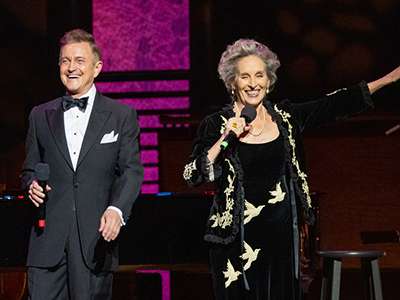
Hosts Andrea Marcovicci and Jeff Harnar (their 13th year) welcomed us and honored the Mabel Mercer Foundation’s namesake with a lighthearted rendition of “The 59th Street Bridge Song (Feelin’ Groovy)” (Paul Simon). “Our North Star tonight has been to create a roster of storytellers,” Harnar noted.
Highlights:
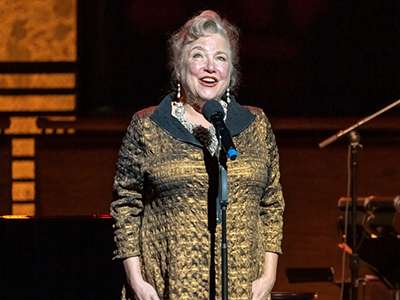
In the course of singing “Mira” (Bob Merrill, from the musical Carnival), Barbara Brussell shed years before our eyes, appearing palpably homesick. A visible inhale on “Can you imagine that?” tremulously glided on bowed bass.
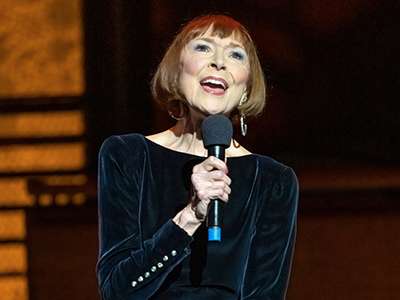
Actress and Francophile Karen Akers offered a bouquet of tenderness. “Matelot” (Noël Coward) and “Autumn Leaves”/“Feuilles Mortes” (Joseph Kosma/Jacques Prevert/Johnny Mercer) arrived lustrous and poignant in French and English. (Alex Rybeck, MD/ pianist.)
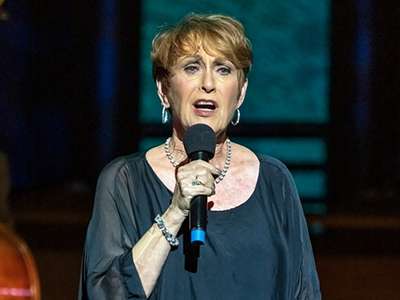
Amanda McBroom’s gently Latin version of “Remind Me” (Jerome Kern/Dorothy Fields) started each phrase high and sashayed down. “Blame It on My Youth” (Oscar Levant/Edward Heyman) sounded bittersweet, as if looking back. (Gerald Sternbach, MD/ pianist.)
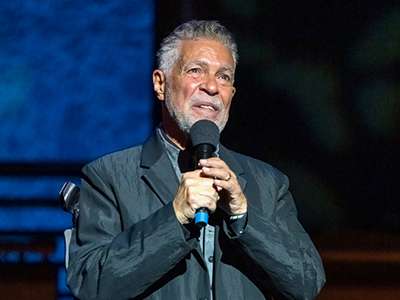
Clint Holmes opened with “1944,” from the musical he’s writing about his parents, who met at a British USO. The song was melodious and touching. In contrast, “It’s All Right with Me” (Cole Porter) emerged amped up and cool. He fingered the microphone as if it were a horn.
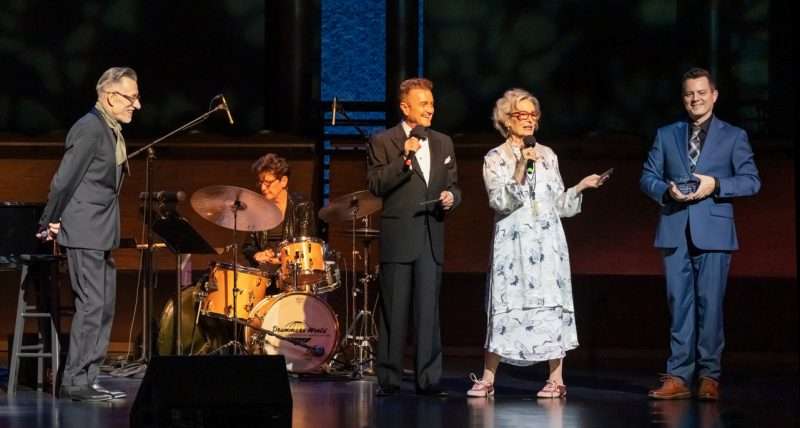
Phillip Officer broke every performance rule by singing “Look at ‘Im” (Merrill) predominantly with his back to audience, gazing at bassist Ritt Henn; yet it worked. (Larry Yurman, MD/pianist.) Officer “…whose unique amalgamation of gifts enables him to sing pure melody of every song while telling the emotional story of every lyric…” (from the award) was then presented with The Donald F. Smith Award endowed by Eleanor and Howard Morgan.
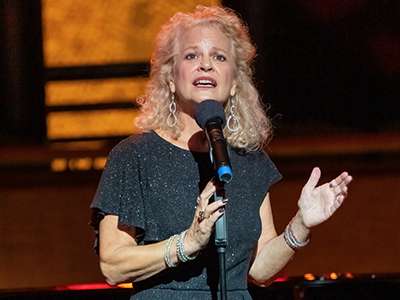
“Wouldn’t It Be Loverly?” (Alan Jay Lerner/Frederick Loewe) and “Little Girl Blue” (Richard Rodgers/Lorenz Hart)—the former song was wisely delivered without ersatz Cockney accent—were showcased by Francesca Amari’s crystalline timbre. (Stenbach, MD/pianist.)

Jeff Harnar, who seems to just keep getting better, gave us an effervescent “It’s De-Lovely” (Porter) with panache, refinement, priceless facial expression, and a dash of Jimmy Durante. Verse after verse were deliciously interpreted. (Rybeck, MD/pianist.)
Wearing a hot-pink shawl that belonged to Mercer that was gifted to her by Donald Smith, Andrea Marcovicci sang “Do You Ever Cross Over to Sneeden’s?” (Alec Wilder). Imagined as a love song to a place (and time), her vocal expressed yearning like the moon pulling at tides.
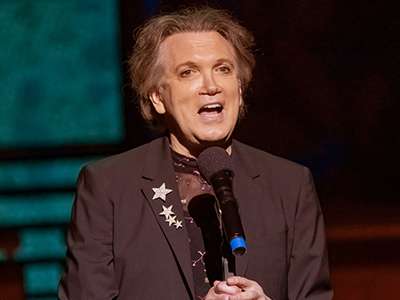
Charles Busch may be the closest artist we have to embody Mercer’s gift. Every lyric he sang was authentic, meaningful, affecting. “Both Sides Now” (Joni Mitchell), including some parlando, was as guileless as we’ve ever heard. “I really don’t know life,” he sighed. (Jono Mainelli MD/pianist.)
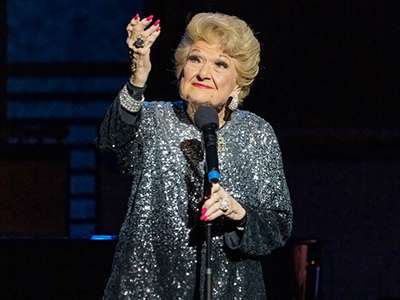
“You’ve been here all night,” Marilyn Maye quipped to the band. “I’m so glad you waited.” The indomitable vocalist arced a relationship from “My Romance” (Rodgers and Hart) to “That’s All” (Bob Haymes/Alan Brandt) with signature presence and flair. (Tedd Firth MD/ pianist.)
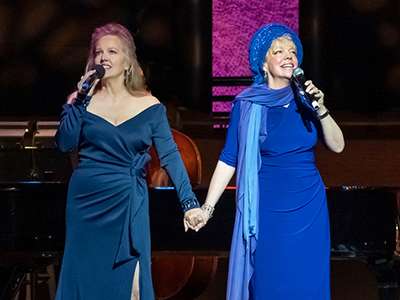
Sisters Stacy Sullivan and KT Sullivan, the latter Artistic Director of the Mabel Mercer Foundation, closed the evening with “As Long as We Sing” inspired by Mabel Mercer, written by their mother, Elizabeth Sullivan.
“As long as we sing, she will sing… as long as we touch another’s heart, the way she knew just how to do… as long as we sing, she’ll be singing too.” It was half anthem, half prayer. The company joined.
Also featured:
MOIPEI (Mary, Maggy, and Marta) performed two songs—“Once in a Blue Moon” and “Wait ’Til You See Her”—with impeccable harmony and lilting, overlapping phrases creating an almost classical feel. (Yurman, MD/pianist.)
Marissa Mulder offered charming songs—“Chase Me Charlie” (Noël Coward) and “While We’re Young” (Alec Wilder/Morty Palirtz/William Engvick), conjuring kinder times.
Songwriter Carol Hall arrived in New York knowing no one, Stacy Sullivan told us. Hearing that Mabel Mercer performed new material, she left a copy of “Jenny Rebecca” at her address and cold-called the vocalist. Mercer liked and sang the lovely ode to Hall’s granddaughter. Sullivan’s version was bathed in warmth. She somehow empathized with both the singer and little Jenny.
The lyrics of “I’m Glad I’m Not Young Anymore” (Lerner/Loewe) were savored by the inimitable Sidney Myer, who drew out each word as if unwilling to let go. (Tracy Stark MD/pianist.)
Tovah Feldshuh spiced up two contributions—“Confessions” and “Ev’ry Time We Say Goodbye” (Porter)—with perfectly toned quotes by Dorothy Parker and a story about her own father. She was in fine voice. (James Bassi, MD/pianist.)
Meg Flather’s “Wait Till We’re 65” (Lerner/Burton Lane) emerged droll and oddly inviting considering its subject. “Hop, skip to forty- Whoo!” she sang (Stark, MD/pianist.)
Avery Somers’ “The Way We Were” (Marvin Hamlisch/Alan & Marilyn Bergman) floated on a gentle jazz piano. Vocal emerged in short phrases, a direct message; no embellishment. Gravitas ruled. (Doyle Newmyer, MD/pianist.)
The house band—Jon Weber (MD/piano), Ritt Henn (bass), Sherrie Maricle (drums)— accompanied tonight’s singers, unless otherwise specified.