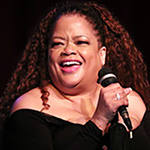

Debbie Wileman
From London with Love
Birdland, NYC, August 31, 2026
Reviewed by Bart Greenberg

Photo by Gabriel Godberg
The lights at Birdland dimmed. The indispensable Billy Stritch was at the piano. From the darkness came a familiar voice. Was it a recording? No. It was live. Then Debbie Wileman came into the light. She didn’t resemble Judy Garland in any way physically, but oh, she did sound like her. She wasn’t doing an imitation of Garland, but she was channeling the late diva—the phrasing, the vibrato, the handling of the corded (thank you very much) microphone. The medley of “Almost Like Being in Love” (Frederick Loewe/Alan Jay Lerner) and “This Can’t Be Love” (Richard Rodgers/Lorenz Hart) was an excellent reduction of Garland’s Carnegie Hall concert version. Given Wileman’s energy and strong personality, this came off as a live performance rather than a pallid imitation.
What followed were reincarnations of Karen Carpenter (“I Can Dream, Can’t I” by Sammy Fain/Irving Kahal), Ann Miller (“Shaking the Blues Away” by Irving Berlin), and Dusty Springfield (“You Don’t Have to Say You Love Me” by Vicki Wickham/Simon Napier-Bell/Pino Donaggio/Vito Pallavicini). She gave us so much more Judy, even when she began “As Long as He Needs Me” (Lionel Bart) as Georgia Brown but smoothly transitioned back to Garland. All these songs were delivered with power and sensitivity, but they weren’t Wileman. When she was chatting with the audience, she was definitely herself: a delightful, warm, funny lady with a penchant for buying second-hand jewelry that had belonged to her musical role models (much to her husband’s despair). She had a slightly naughty sense of humor and a warm comradery with Stritch. After an early show business career that flattened out, she returned to performing during the pandemic shut down, in part inspired by Stritch’s own video series from home. Their duet of “Since You Left New York” (Stritch) was one of the warmest and most honest of the evening. Wileman also gave us a great turn as Eliza Doolittle on “Just You Wait” (Lerner/Loewe) in which she used an accent far more accurate and natural than what we usual hear.
Perhaps because of her early failure in the entertainment business, she felt more comfortable portraying other successful divas. That may also explain her tendency to retreat upstage for too much time during her show. With her clarion voice and charming personality, she should be center stage and all times as herself. Perhaps that will come with her next show.