

Karen Akers
Come With Me to Paris
Birdland, NYC, September 16, 2025
Reviewed by Alix Cohen
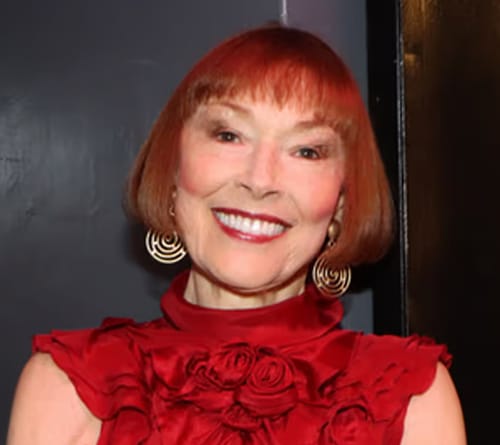
Photo by Kevin Alvey
Karen Akers may be a reincarnated French woman. Her love of Paris runs beyond personal experience to a kind of saudade—a Portuguese word for a deep emotional state of melancholy longing for something absent that might never have existed. In this rhapsodic show she shared the heart and soul of her connection to Paris.
Stephen Sondheim’s “Ah Paree” (Follies) unfurled with evangelistic relish. An infectious tingle ran through the club. “The Last Time I Saw Paris” (Jerome Kern/Oscar Hammerstein II) palpably ached. Non, the artist would not allow those feelings yet. “Sous le ciel de Paris” (Hubert Giraud/Jean Drejac) danced to MD/pianist Alex Rybeck’s graceful waltz. An English translation of the marvelous lyrics would have helped, but there was no mistaking Akers’ joyful intoxication.
“Bon soir mes amis, bien venus a Birdland. Je suis si heureuse d’etre revenue avec une nouvelle spectacle.” The artist addressed us in fluent French, but then said “Excusez moi, I get carried away.”
“Darling, Je Vous Aime Beaucoup” (Anna Sosenko) arrived in wry Franglais: “Darling, je vous aime beaucoup/Je ne sais pas what to do/You know you’ve completely/Stolen my heart.” A wonderful poem by James Laughlin followed, and there was a distinct twinkle in her eye. This is an actress. “La vie en rose” was initially titled “Les choses en rose”—things in pink. (through rose-colored glasses?). Piaf didn’t think she was glamorous enough to record it, Akers told us. She offered the song to Marianne Michel, who modified the original lyrics by changing “les choses” (“things”) to “la vie” (“life”). (Edith Piaf/Louis Guglielmi, known as Louiguy). With her back against the piano, Akers effortlessly rolled her rs and imbued the classic song with love as an elemental force: “As soon as I notice him/I feel inside me/My heart beating…Lalalala, lalalala”
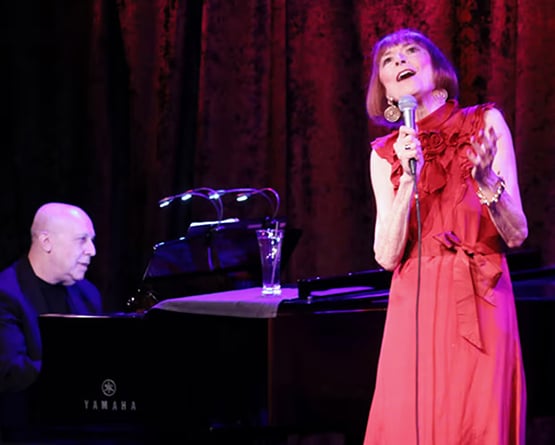
Photo by Kevin Alvey
Michel Emer’s “L’Accordéoniste” is the story of a prostitute in love with a musician who plays the dance “java” at a local club. She goes there after work every night. They make plans, but he’s conscripted and dies at war. There’s a new accordioniste. She closed her eyes trying to let the music sweep her away, but instead she breaks down. The translation was gifted to Akers by its author, Sheldon Harnick. This may have been the first time it was performed in public. As might be expected from this masterful lyricist, it was marvelous. We saw her as a 1940s chanteuse in a boîte de nuit.
“No one loved Paris like Cole Porter,” introduced “I Love Paris” and “You Don’t Know Paree.” The songs were tender and breathy. History, real or imagined, draped the artist’s shoulders with the weight of a velvet cape. “Paris in the Rain” (Cora Vaucaire/English lyric by Jeremy Sams), sung to a delicate oom pah pah rhythm, tried to sustain a pastel dream: “They all said life goes on/They all said you’ll forget.” The song’s frustrated punch line was sheer Akers.
“Another Song About Paris” (Dave Frishberg) emerged with its clever, rhyming clichés, was perhaps the single parentheses of humor in the show. Another would be welcome. “Au coeur de septembre” (Joseph Kosma/Eddy Marnay), “Try to Remember” (Tom Jones/Harvey Schmidt), and “Les feuilles mortes” (“Autumn Leaves”) (Kosma/Jacques Prevert), sung partly in French, partly in English, appeared to rise from direct memory. The arrangement was as beautiful as it was bruised.
Two songs by Jacques Brel seemed requisite inclusion. “Song for Old Lovers” (English lyrics by Eric Blau & Mort Shuman) revealed pride, regret, loneliness, gratitude. Akers is not a performer who thinks in simple terms. “Marieke” erupted as a spellbinding torment; Akers wrung her hands. The piano opened lapping and then majestically surged, bearing the vocalist aloft. For moments afterward, she remained shredded as did we.
The show closed with Akers’ recollection of visiting Piaf’s restored Paris apartment which led, of course, into “Non, je regretted rien.” (Charles Dumont/Michel Vaucaire). This wrenching anthem might be as true to this artist as it was to Piaf. “Sincerity is the key to my heart; it opens the door to true connection.” (Edith Piaf)
Direction by Sara Louise Lazarus was subtle and effective. No gesture occurred that was not an organic extension of emotion. In this show, Karen Akers connected with her rapt audience.